
Why Iterate for AI Economics

Make enterprise AI faster, cheaper, and deployable on your terms.

AI costs and latency can rise quickly as prototypes become daily workflows. Iterate helps enterprises optimize runtime performance, route work across the right models, reduce unnecessary token spend, and run AI in private or edge environments where economics and control matter.
Header image

"AI is becoming expensive or too slow as usage scales. We need better economics, concurrency, latency, and deployment flexibility."

AI economics break when usage scales.

Enterprise AI pilots often look affordable until adoption grows across teams, agents, documents, and workflows. Runtime strategy becomes a board-level cost and performance question.

Variable model costs

Per-token usage can climb as AI moves into high-volume work.

Latency bottlenecks

Slow responses reduce adoption and make agentic workflows harder to trust.

Concurrency limits

More users, agents, and workflows create performance pressure.

Private AI cost concerns

Running private models can feel expensive without the right runtime and routing strategy.

Provider dependence

One provider strategy can create cost, resilience, and deployment constraints.
Why Iterate

Optimize the runtime, not just the prompt.

Iterate combines Generate, Lifeboat, and AgentWatch to improve AI execution economics across private, public, edge, and hybrid environments.

Match work to the right runtime

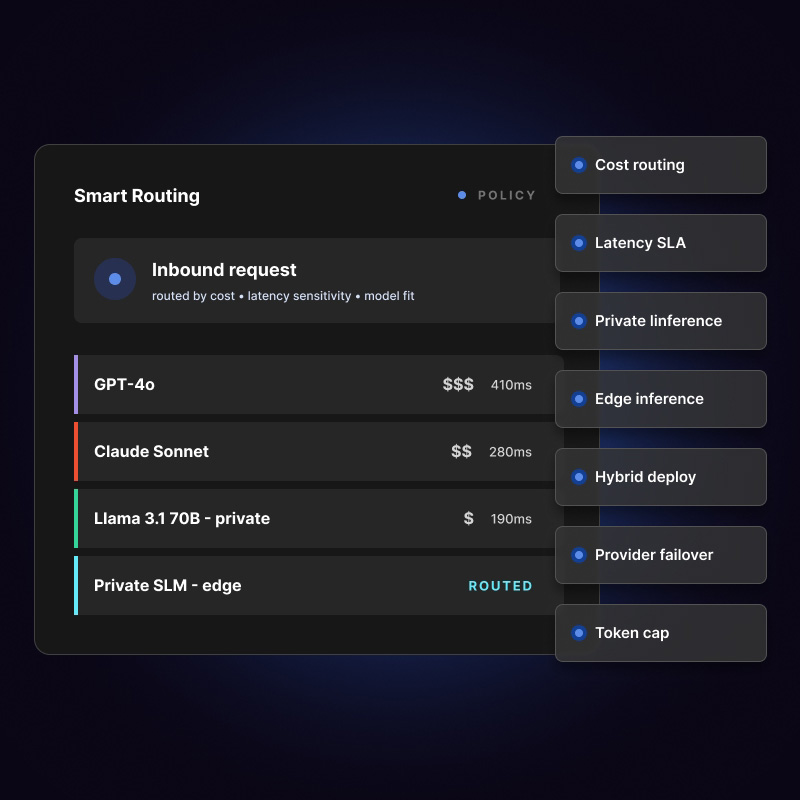
Route tasks by cost, latency, data sensitivity, model fit, and infrastructure requirements.

Reduce wasted compute

Use runtime-aware orchestration, token controls, memory optimization, and caching strategies.

Support private scale

Make on-prem, VPC, edge, and hybrid deployment more practical for sensitive enterprise workloads.

Measure every decision

Track usage, cost, latency, throughput, and provider performance so optimization becomes continuous.
Capabilities

Runtime and economics capabilities

Optimize AI runtimes, routing, cost, latency, resilience, and deployment across public, private, edge, on-prem, and hybrid environments.

Inference optimization for LLM and SLM workloads
Runtime-aware orchestration for agentic workflows
KV-cache and memory optimization strategies
Model routing based on cost, latency, policy, or task type
Edge, private cloud, on-prem, and hybrid deployment patterns
Token cost controls and usage visibility
Latency reduction and response-time monitoring
Concurrency improvement for high-volume AI workloads
Routing across public, private, and custom models
Failover and resilience planning for provider or runtime degradation
Business Value

Control that supports adoption.

Enterprise AI governance should reduce risk without forcing teams back into experimentation silos.

Lower AI execution costs.

Improve response times for users and agents.

Make private AI more viable at scale.

Reduce dependence on expensive or overpowered model calls.

Support high-volume enterprise AI workloads.

Improve the economics of agentic workflows.

AI Runtime and Cost Assessment

Identify where AI cost and latency can be reduced.

Iterate reviews your AI workload patterns, model usage, latency targets, data sensitivity, and deployment requirements to recommend a runtime architecture that balances performance, privacy, and economics.
Workload and usage-pattern review
Cost, latency, and concurrency baseline
Model routing and private deployment recommendations
Runtime optimization roadmap
Executive summary for IT, finance, and platform teams
FAQ

Common buyer questions

Is runtime optimization only for companies running private models?
No. It applies to public model usage, private model usage, and hybrid strategies where routing and cost visibility matter.
Does this help agentic workflows?
Yes. Agentic systems often make multiple model calls, tool calls, and checks, so runtime economics matter even more.
Can this reduce LLM provider spend?
The assessment identifies routing, model choice, token control, caching, and workflow design opportunities that can reduce avoidable spend.
Who is the buyer for this page?
CTO, VP engineering, platform teams, AI infrastructure leaders, CIO, CFO, and product owners scaling AI usage.