
Why Iterate for Agentic AI

Turn promising AI demos into governed production agents.

Chatbot demos are easy to show and hard to operate. Iterate helps enterprises build agentic systems that connect to real tools and data, follow approval paths, stay observable, manage cost, and scale across business workflows.
Header image

"We can build demos, but we need production-grade agents that are integrated, governed, observable, and scalable."

The hard part is not the demo. It is production.

Enterprises need agents that behave predictably inside real systems, not isolated prompt experiences that cannot be audited, controlled, or scaled.

Demo-to-production gap

Prototype agents often lack deployment, monitoring, and operational controls.

Integration friction

Agents need safe access to APIs, databases, documents, and enterprise systems.

Behavior risk

Agent actions need guardrails, evaluator patterns, and escalation paths.

Missing human controls

Many workflows require approvals, review steps, and exception handling.

Unclear economics

Multi-step agents can multiply model usage and runtime cost.
Why Iterate

Build agents as governed workflows.

Iterate combines Generate, Interplay, and AgentWatch so enterprises can design, deploy, monitor, and improve production agents across teams and systems.

Orchestrate real work

Connect agents to tools, documents, databases, APIs, and workflows.

Govern behavior

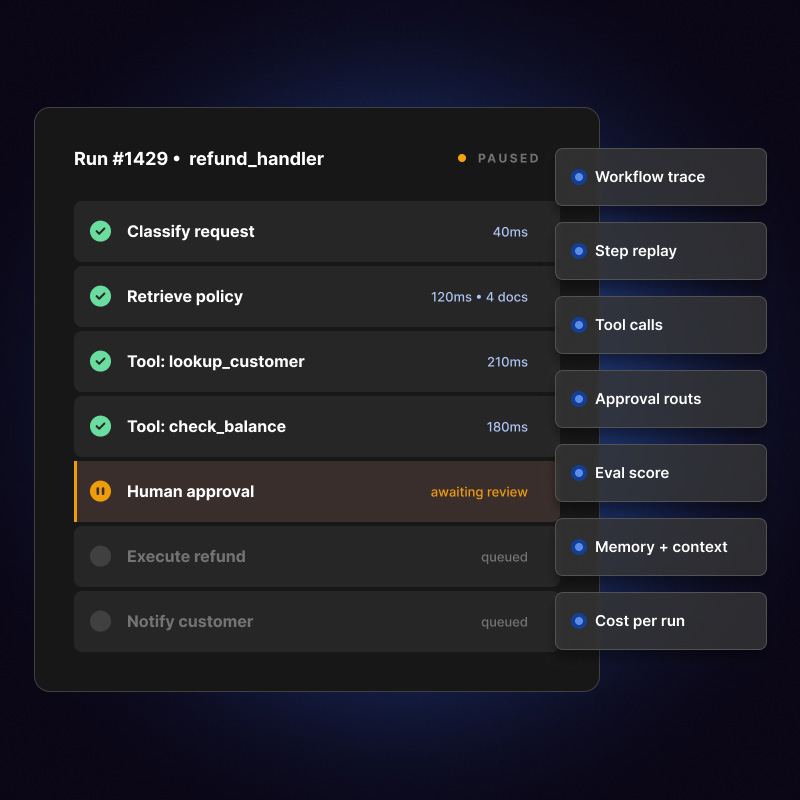
Add guardrails, approval gates, evaluator-checker patterns, and audit trails.

Observe operations

Track model usage, tool calls, cost, latency, errors, and outcomes.

Scale responsibly

Reuse templates, routing strategies, and deployment patterns across teams.
Capabilities

Production agent capabilities

Build, orchestrate, observe, and govern production AI agents across enterprise systems, models, and deployment environments.

Agentic workflows and task orchestration
Tool integration across APIs, databases, storage, and business systems
Retrieval-augmented generation for enterprise knowledge
Routing, handoffs, and multi-agent workflow patterns
Memory and context management
Evaluator-checker patterns for reliability
Human approval gates and exception workflows
Observability for prompts, actions, errors, latency, and cost
Multi-model routing and private model support
Workflow deployment across cloud, on-prem, and hybrid environments
Business Value

Control that supports adoption.

Enterprise AI governance should reduce risk without forcing teams back into experimentation silos.

Move beyond chatbot demos.

Build agents that support real business workflows.

Reduce operational and compliance risk.

Govern agent behavior across models, tools, and users.

Improve reliability with evaluator, approval, and monitoring patterns.

Scale AI workflows across departments and processes.

Agentic Architecture Workshop

Design the agent architecture before you scale it.

Iterate works with your business, IT, data, and security stakeholders to map agent use cases, systems, approval paths, model strategy, governance needs, and deployment requirements.
Prioritized agentic use case map
Workflow architecture and integration blueprint
Governance, approval, and observability requirements
Model routing and runtime strategy
Pilot roadmap with success metrics
FAQ

Common buyer questions

What makes an agent production-ready?
A production agent is integrated, governed, observable, measurable, secure, and connected to the workflows it is expected to support.
Can agents run against private enterprise data?
Yes. The architecture can use private retrieval, private deployment, and policy controls so sensitive data remains governed.
Do business users need to code?
Some workflows can be assembled visually or from templates, while engineering teams can extend deeper integrations when needed.
Who is the buyer for this page?
CIO, CTO, VP AI, operations leaders, product leaders, innovation teams, and platform teams moving agentic AI into production.